Amiri Staff Mobile Application
Lead developer on a Flutter app trusted across the departments of a public hospital. I was the lead developer end to end — from requirements and architecture through development and deployment.
- Role
- Lead developer · Requirements → deployment
- Context
- Amiri Hospital · Healthcare
A private, internal enterprise app for hospital staff — distributed via a private, unlisted link, not publicly listed.
- Flutter
- Dart
- Secure APIs
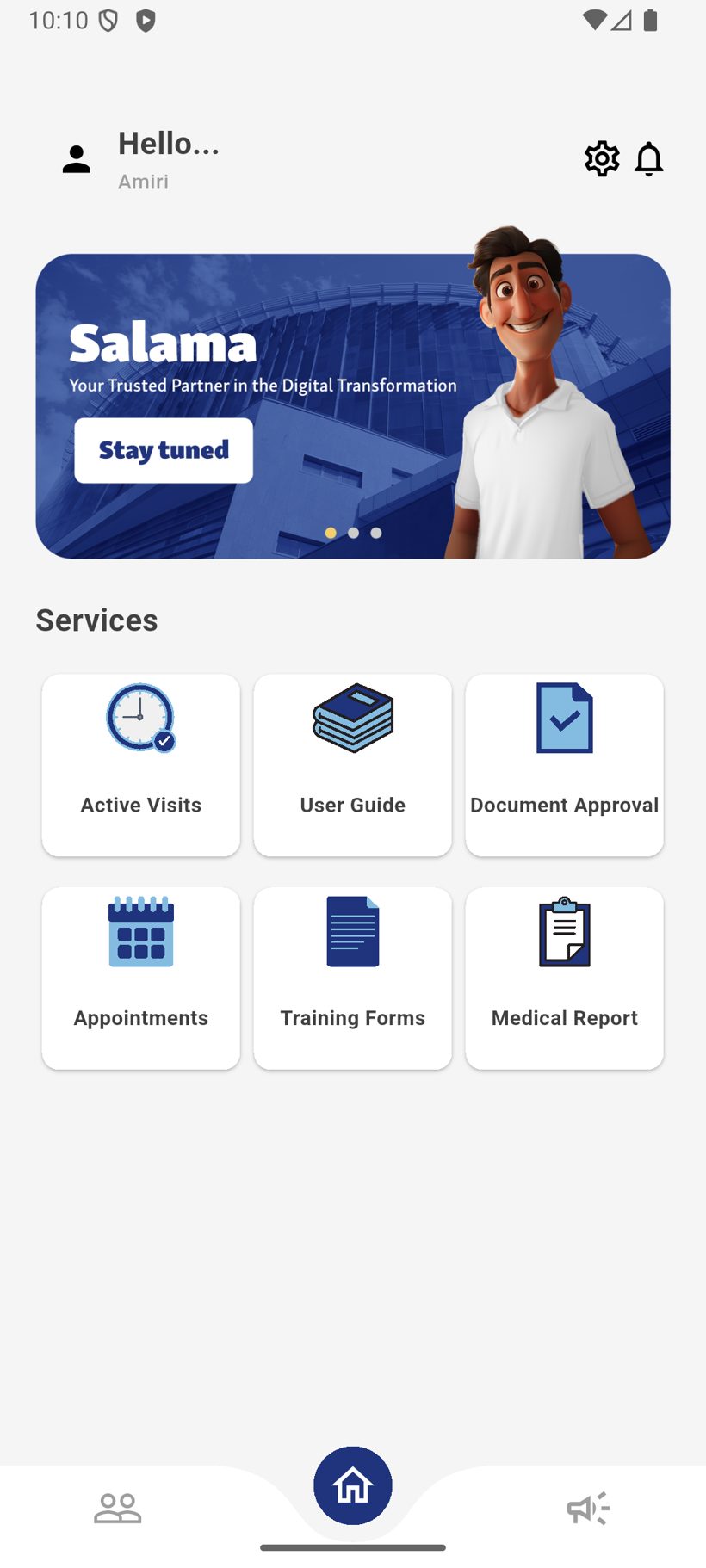
The staff app of a public hospital, used across departments for approvals, appointments, and daily services.
- Context
- Amiri Hospital's staff work across departments and shifts — their daily services needed to reach them on their phones, connected to the hospital's internal systems.
- Problem
- Approvals, appointments, and reports depended on desktop systems and paper — slow for staff who are rarely at a desk.
- What I built
- A staff mobile app covering daily services — approvals, appointments, training, and reports — integrated securely with the hospital's management platform.
- My responsibility
- Lead developer end to end — requirements with stakeholders, architecture, development, and deployment.
- Verified outcome
- In use across the hospital's departments, distributed privately to staff — details kept at a public level for a healthcare client.
- Technology
- Flutter — one codebase for iOS and Android — talking to the hospital's systems only through secure APIs.
The trust story
Fazea is the solo-founder story; this is the enterprise-trust story. Building software that hospital staff rely on across departments is a different discipline from shipping a consumer app. The work is defined less by feature velocity and more by getting requirements right, integrating carefully with systems of record, and deploying software that people depend on in a clinical setting.
What I did
I led the app end to end: gathering and shaping requirements with stakeholders, designing the architecture, building it in Flutter, and taking it through to deployment. Being the lead developer on a system used across a hospital's departments meant owning both the engineering and the reliability and correctness expectations that come with an enterprise healthcare client.
Integration
The app integrates with Derwaza, the hospital's management system, over secure APIs. Derwaza in turn integrates with Ministry of Health platforms — so the app sits inside a larger, security-sensitive ecosystem where correct, careful integration matters more than moving fast.
The ability to be trusted as the lead on enterprise software: translating stakeholder requirements into architecture, integrating responsibly with critical systems of record, and shipping software real staff depend on — in a domain where the bar for correctness and confidentiality is high.
This is a hospital client, so this case study is kept at a public level. The home screen is shown with clearance; other internal screens, data, and architecture details are kept private.